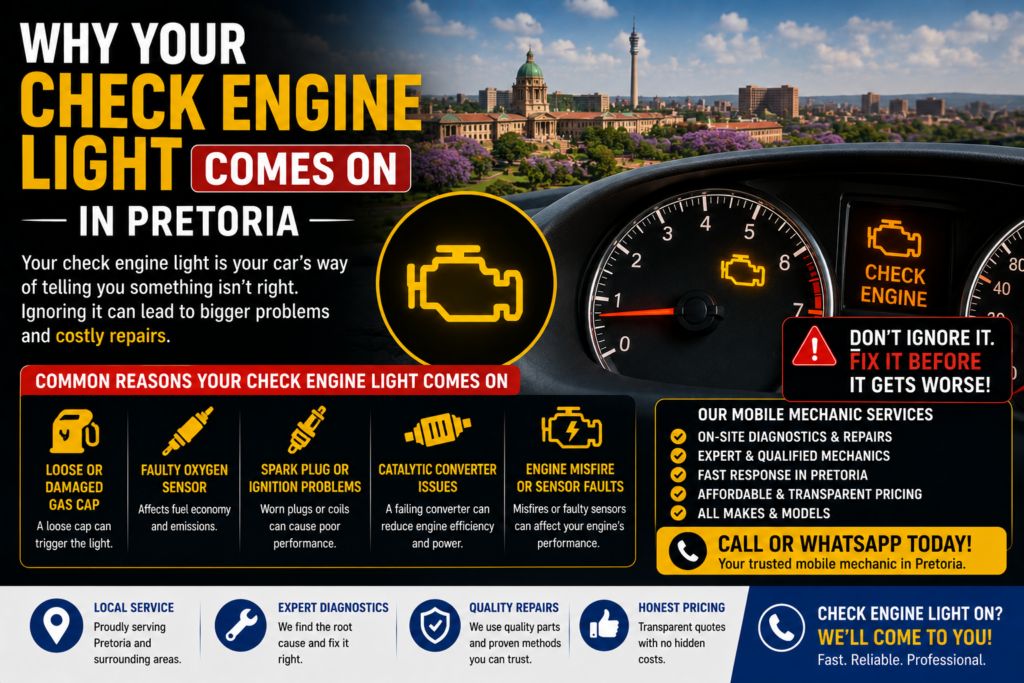
Why Your Check Engine Light Comes On in Pretoria
Few dashboard warnings cause as much concern as the check engine light. For some drivers it appears suddenly while driving. Others notice it after starting the vehicle in the morning. Sometimes the vehicle feels completely normal, while in other cases the engine runs poorly, loses power, or struggles to start.
The challenge is that the check engine light does not identify a single fault. It simply tells you that the vehicle’s computer has detected a problem somewhere within the engine management system. That problem could be minor, or it could be the early warning sign of a more serious issue.
At Pretoria Mobile Mechanic, one of the most common call-outs we receive involves engine warning lights. Understanding what causes them can help drivers make better decisions and avoid unnecessary repairs.
What Does the Check Engine Light Actually Mean?
Modern vehicles use dozens of sensors to monitor engine performance, fuel delivery, emissions, ignition timing, airflow, temperatures, and electrical systems. Whenever the vehicle detects a reading outside expected limits, it stores a fault code and may activate the check engine light.
The important thing to understand is that the warning light itself is not the fault. It is simply an indicator that something else needs investigation. This is why guessing or replacing random parts often becomes expensive.
Many drivers clear the warning light using a scan tool without fixing the underlying issue. In most cases the light simply returns because the actual fault remains unresolved.
1. Faulty Sensors
One of the most common causes of a check engine light is a faulty sensor. Modern vehicles rely heavily on sensors to calculate fuel delivery, monitor emissions, and maintain efficient engine performance.
Common sensor-related faults include:
- Oxygen sensor faults
- Mass airflow sensor problems
- Crankshaft sensor issues
- Camshaft sensor faults
- Temperature sensor failures
- Boost pressure sensor faults on turbo vehicles
A failed sensor may not immediately stop the vehicle from running, but it can affect fuel economy, engine performance, emissions, and starting reliability.
2. Ignition System Problems
Ignition faults are another major trigger for engine warning lights. Spark plugs, ignition coils, wiring, and related components must work together correctly for efficient combustion.
When a cylinder misfires, the engine management system quickly detects the imbalance and often activates the warning light.
Signs of ignition-related problems may include:
- Engine hesitation
- Rough idle
- Poor fuel economy
- Loss of power
- Jerking during acceleration
- Hard starting
If ignored, misfires can eventually damage catalytic converters and create much larger repair bills.
3. Fuel Delivery Issues
Fuel system faults can also trigger engine warning lights. Modern engines require precise fuel delivery, and even small deviations can cause warning lights and performance problems.
Potential causes include:
- Weak fuel pumps
- Blocked fuel filters
- Dirty injectors
- Fuel pressure regulator faults
- Fuel contamination
Many fuel-related faults begin with minor hesitation or rough running before becoming more serious.
If your vehicle has recently lost power or struggled to accelerate, this may be connected to the warning light.
4. Emissions System Problems
A large percentage of check engine lights are connected to emissions systems. These systems are designed to reduce harmful exhaust emissions while helping the engine operate efficiently.
Common examples include:
- Oxygen sensor failures
- Catalytic converter issues
- EVAP system faults
- Air leaks in intake systems
- EGR valve problems
Some emissions-related faults have little effect on drivability initially, which is why many drivers ignore them. However, the underlying issue can still become more expensive if left unresolved.
5. Electrical Problems
Modern vehicles depend heavily on electrical systems. Poor voltage, wiring faults, alternator issues, battery problems, or damaged connectors can all affect engine management systems.
This is one reason why warning lights sometimes appear alongside:
- Battery warning lights
- Hard starting
- Random electrical faults
- Intermittent warning messages
- Dashboard errors
Electrical problems can be difficult to diagnose without proper testing, which is why structured fault-finding is important.
Can You Keep Driving With the Check Engine Light On?
The answer depends on the fault. Some issues are relatively minor, while others can cause severe engine damage if ignored.
If the vehicle develops any of the following symptoms, it should be inspected immediately:
- Severe loss of power
- Misfiring
- Overheating
- Flashing check engine light
- Strong fuel smell
- Repeated stalling
A flashing check engine light is generally more serious than a steady light because it often indicates active misfires that can damage other components.
Why Proper Diagnostics Matters
Many drivers search online for a warning light, see a list of possible causes, and start replacing parts. Unfortunately, dozens of different faults can trigger similar warning lights.
Proper diagnostics involves reading fault codes, verifying sensor readings, inspecting components, confirming symptoms, and identifying the actual cause before repairs begin.
This process helps avoid:
- Unnecessary parts replacement
- Repeat breakdowns
- Incorrect repairs
- Wasted money
- Long-term vehicle damage
For professional fault-finding, visit our Car Diagnostics Pretoria page.
FAQ: Check Engine Light Pretoria
Can a bad battery cause a check engine light?
Yes. Low system voltage and charging problems can sometimes trigger engine management warnings.
Should I clear the fault code myself?
Clearing the code without identifying the cause usually results in the light returning later.
What if my car feels normal?
The issue may still require attention. Some faults affect emissions or efficiency before drivability becomes noticeable.
Can a mobile mechanic diagnose warning lights?
Yes. Many warning-light faults can be diagnosed at your home, workplace, or roadside location.